Measuring the speed of light with chocolate
If you’ve ever made brownies or chocolate cake, you might have had to melt chocolate in a standard 2450 MHz microwave oven. While it seems uninteresting at first, we can actually estimate the speed of light using hotspots on a microwaved chocolate bar.
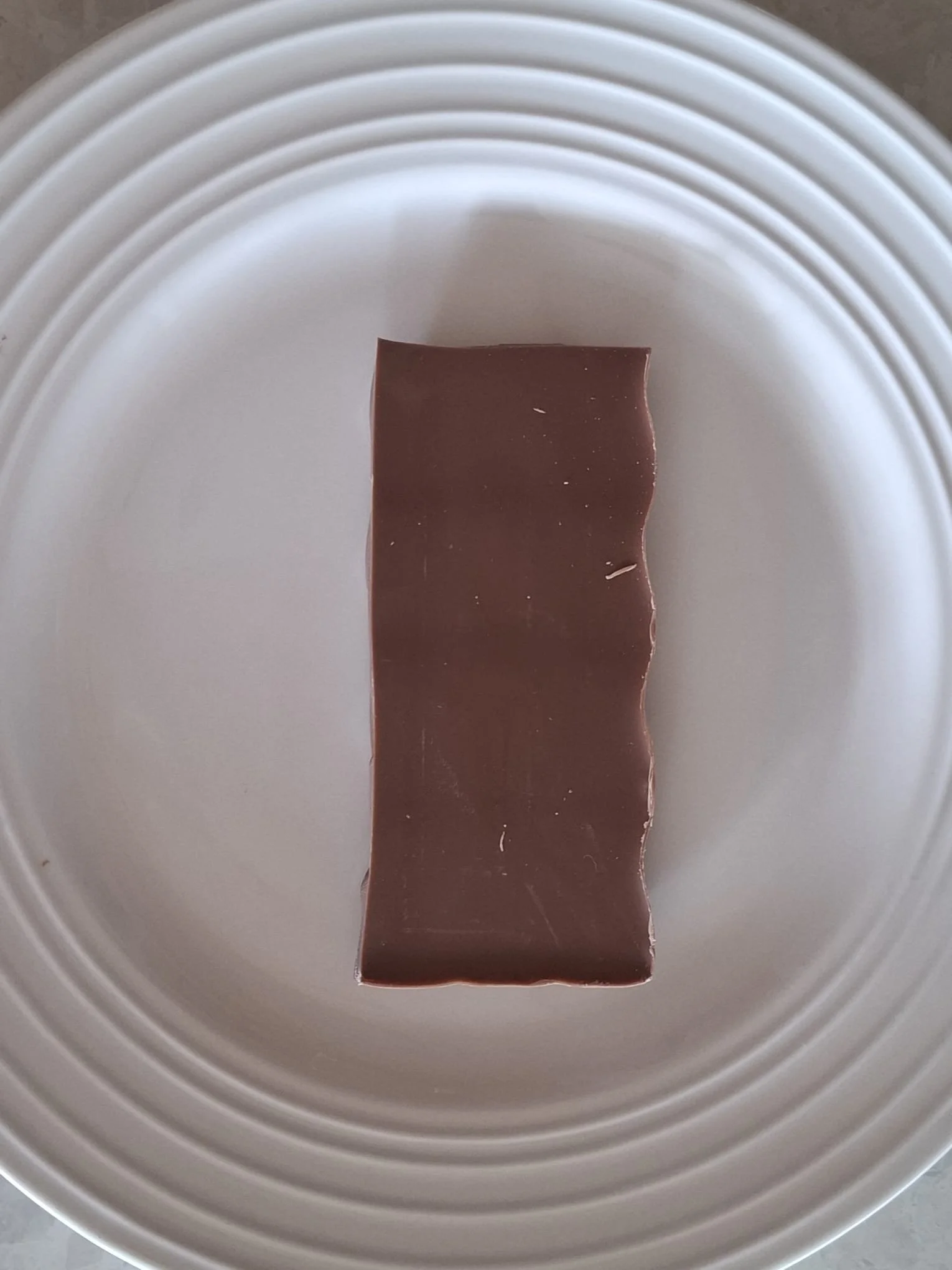
First, remove the turntable and wheels from the microwave. Unwrap a solid chocolate bar (it must be one without any fillings or toppings*) and place it in the centre of the microwave on a plate like below.
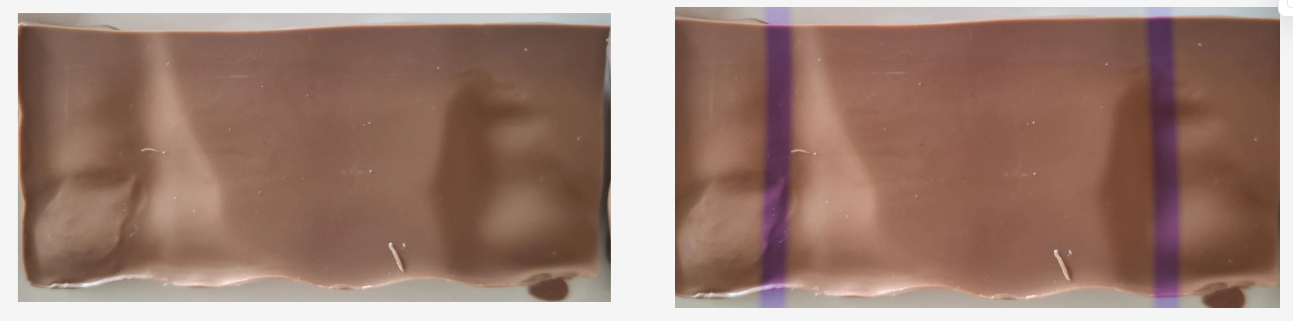
Then set the microwave to run for around 20 seconds. You should see at least 2 spots where the chocolate has significantly melted, and other spots where the chocolate is still solid. If the chocolate bar is completely unmelted, microwave it for a further 10 or 20 seconds. If the chocolate bar has completely liquified, allow it to solidify in the freezer before reattempting.
Stationary waves (sometimes called standing waves) appear in the oven as microwaves reflect from the walls and interfere with the incident waves. Where the reflected and incident waves meet in phase (peaks meet peaks or troughs meet troughs), the amplitude of the resultant wave is higher, and we call these points antinodes. The energy transferred by the wave at antinodes is higher, since power is proportional to the amplitude squared. This results in more melting. These “hotspots” are half a wavelength apart from each other (as troughs and peaks are also half a wavelength from each other).
Using a ruler, measure the distance between the centres of 2 hotspots. This distance is half of a wavelength of light, so multiply it by 2.
In my experiment, this distance between hotspots (marked with purple lines) was around 6cm (2.4 inches in freedom units).
If 6cm is half a wavelength, then 12 cm, or 0.12 m, is a full wavelength.
Your microwave will tell you which frequency it uses, which is generally always 2450 MHz or 2.45×10^9Hz.
The speed of an electromagnetic wave is equal to the frequency x wavelength, and so the speed of light, as measured in my experiment, was:
(2.45×10^) x (0.12)=2.94×10^8 m/s
The true value is actually 3×10^8 m/s, so we are close.
You can use this practical to demonstrate both the wave speed equation and the properties of stationary waves. It works well in classrooms and is relatively safe.
*I previously attempted this with a caramel Aero bar. For those who don’t know, these are chocolate bars in the UK with a crumbly, sponge-like inside. The caramel absorbs microwaves far quicker than the surrounding chocolate, leading to hotspots where the caramel is, rather than where the microwave antinodes have formed, so you will not be able to get an accurate measurement.