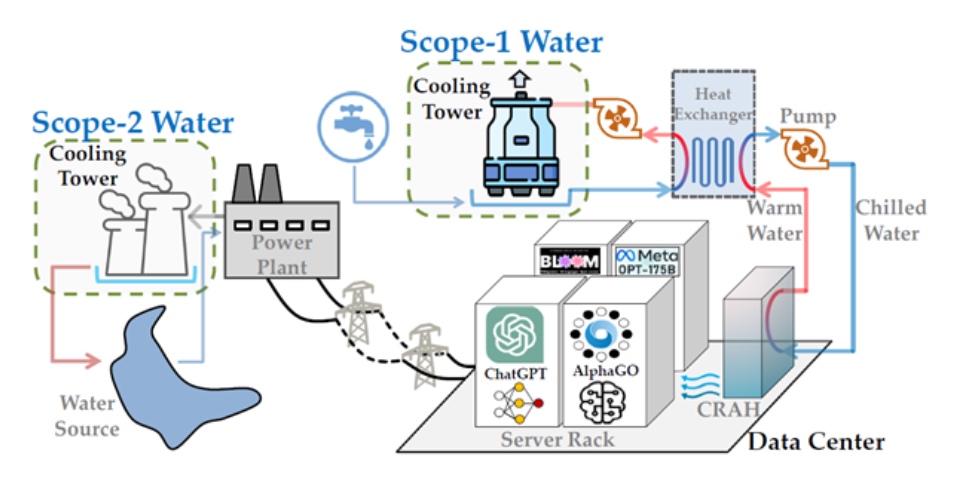
How much water does AI actually use?
You may have heard information floating around social media about how much water AI “uses”*. I personally have heard figures from “one water bottle per prompt” to “0.3 milliliters per prompt”. It is important to question the legitimacy of any statistical claims you hear on social media.
To look at more in depth research, look at The water footprint of artificial intelligence: Emerging solutions and governance imperatives by Zohar Barnett-Itzhaki.
The real answer depends on factors including the type of model, length of prompt, the type of task, etc. For example, more advanced models completing more advanced tasks requiring longer answers will consume more water. Li et al. (2024) estimated that GPT-3 generating 10–50 medium-length responses consumes the equivalent of a 500 milliliters (contrary to the claim that this is the water consumption per prompt).
However, I would like to point out a different problem with this type of misinformation. Primarily, the fact that it may disproportionately emphasises the environmental damage caused by AI compared to other behaviours. You can see more information about the emissions and water consumption linked to your actions here. But this is just one example:
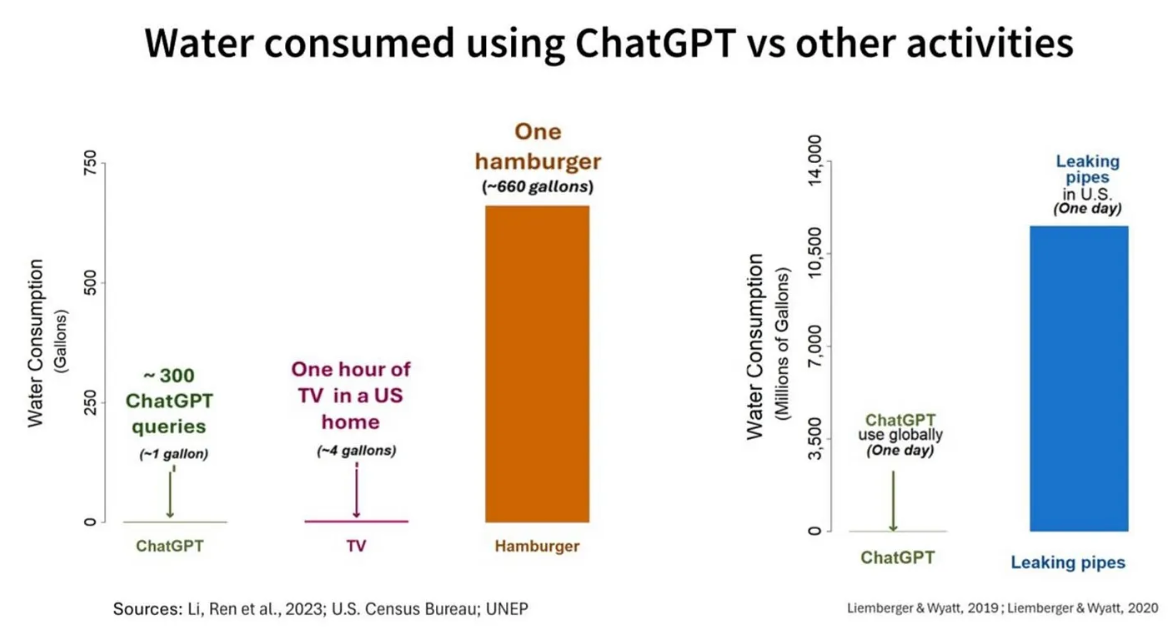
There are several activities that consume more water than AI LLMs but are not given the same kind of publicity. The point is not necessarily that using ChatGPT is completely harmless, but that you are far better off being vegan, avoiding air travel, or switching to an electric car if your goal is to minimise GHG emissions and water consumption. Take care when listening to unsubstantiated information online.
*To be clear, AI uses water in a few different ways.
Primarily, freshwater is needed to cool down the datacentres which run computer chips. Using AI requires complex calculations that other tasks do not, and so more water is necessary to maintain the same functional temperature. (Li et.al)
This is what we mean when we say AI “water consumption”.